


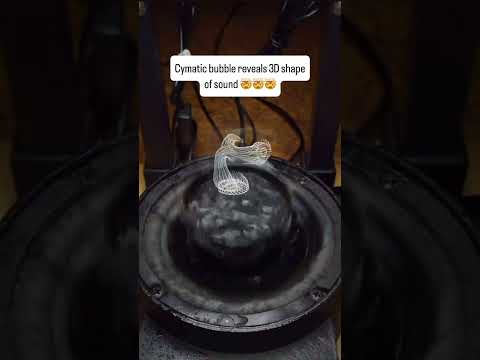

When a soap bubble is placed on a vibrating speaker, it becomes a fascinating three-dimensional canvas for visualizing acoustic resonance patterns. As sound waves propagate through the bubble’s thin membrane, they create standing wave patterns that manifest as intricate geometric forms visible on the bubble’s surface.
The bubble acts as a spherical resonator, where specific frequencies create nodes and antinodes that organize into complex three-dimensional patterns. At certain resonant frequencies, these patterns can form toroidal (doughnut-shaped) structures, where the vibrations create circular flow patterns around the bubble’s surface. The membrane oscillates in coordinated waves, with some regions remaining relatively still while others pulse rhythmically.
By modulating the frequency of the speaker, you can watch these patterns transform in real-time. Lower frequencies might produce simple, symmetrical patterns with just a few nodes, while higher frequencies can generate incredibly complex geometries with dozens of interconnected cells, polygonal shapes, and intricate lattice structures. The patterns often exhibit remarkable symmetry, creating pentagons, hexagons, and other regular polygons that seem to dance and morph as the frequency changes.
This phenomenon demonstrates how acoustic energy naturally organizes itself into mathematical forms, revealing the hidden geometry of sound waves in three dimensions. The bubble essentially becomes a living visualization of cymatics (the study of visible sound) showing how vibrational energy seeks order and creates beautiful, ephemeral sculptures in the air.
🎥 @zulucymatics
#science #acoustics #cymatics #standingwave
