


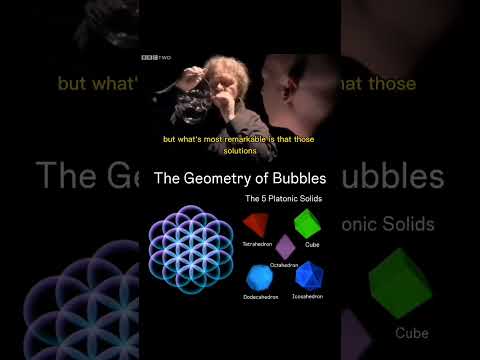

The geometry of bubbles is a fascinating subject that has captivated people for centuries. The physics of bubbles is complex, but it can be understood by examining the geometry of bubble packing.
One of the key properties of bubbles is their ability to pack together in a highly efficient manner. When bubbles touch each other, they naturally form geometric shapes, such as polygons and polyhedra (pentagon, tetrahedron, cube, dodecahedron…) and a lattice-like structure known as a hexagonal packing. This type of packing is commonly found in nature, and it is the most efficient way for bubbles to pack together.
The hexagonal packing of bubbles is a result of the surface tension of the soap film. When two bubbles come into contact, the surface tension of the soap film causes the bubbles to stick together. This creates a small amount of energy, known as the surface energy, which is stored in the film. The surface energy of the soap film is minimized when the bubbles are arranged in a hexagonal packing.
The geometry of bubble packing can be used to understand the stability of bubbles. When a bubble is blown in the air, it is subjected to a variety of forces, including gravity, air resistance, and surface tension. The shape of a bubble is determined by the balance of these forces.
The surface tension of the soap film is what gives a bubble its spherical shape. When a bubble is blown, the surface tension of the soap film acts to pull the bubble into a sphere. This is because the surface tension is greatest at the edges of the bubble, where it is stretched the most.
However, the shape of a bubble is also influenced by the other forces acting on it. Gravity, for example, acts to pull the bubble downward, causing it to become elongated. Air resistance also plays a role, as it acts to slow the motion of the bubble and cause it to become more rounded.
The geometry of bubble packing can also be used to understand how bubbles interact with each other. When two bubbles come into contact, the surface tension of the soap film causes them to stick together. This creates a small amount of energy, known as the surface energy, which is stored in the film.
🎥 The Code, Prof. Marcus du Sautoy
#marcusdusautoy #mathematics #geometry #platonicsolids #patterns
