


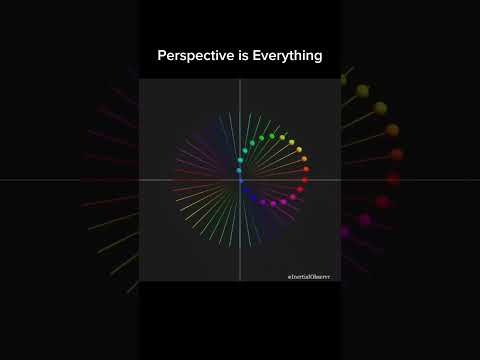

Vision feels direct, yet what appears as depth comes from interpretation built step by step inside the mind. Lines on a flat surface can suggest distance through convergence, and simple shading can create the sense of volume even when nothing extends beyond the plane. Perspective drawing shows this clearly because parallel lines seem to meet at a point, even though they never do in physical space.
Geometry offers a way to observe this without guessing. A curve like a hyperbola exists as an equation on a plane, yet when extended and visualized, it suggests motion and expansion that feels spatial. The same applies to projections of higher dimensions, where a cube can unfold into a net or a tesseract can be represented in three dimensions, even though its full structure cannot be directly perceived.
Daily perception follows similar rules. The brain receives light patterns and organizes them into forms that feel solid and stable. Over time this becomes automatic, and the constructed image feels indistinguishable from reality itself. Looking at geometric patterns makes it easier to notice that this construction is happening continuously.
Once that becomes familiar, perception starts to feel more flexible. The same world remains present, yet the way it is experienced begins to open, allowing a different relationship with space, form, and the patterns that shape everyday life.
🎥 inertial.observr
#geometry #perception #consciousness #perspective
