


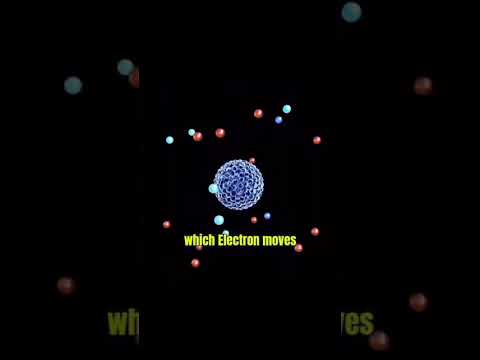

Most people grow up assuming that when two objects touch, their atoms come into direct contact. Modern physics reveals a far more fascinating picture. At the atomic scale, matter is composed primarily of empty space, with a dense nucleus surrounded by a cloud of electrons.
When a hand presses against a table, the atoms within the hand do not actually merge with the atoms within the table. Instead, the electrons surrounding those atoms interact through the electromagnetic force. Because electrons carry the same negative charge, they repel one another. That repulsion creates resistance, pressure, and ultimately the sensation we interpret as touch.
What feels like solid contact is actually an interaction between fields. The experience of touching something emerges from the exchange of forces occurring between countless atoms, all responding to the fundamental laws governing matter and energy. Every object that appears solid is held together by these interactions, creating the stable structures that define the physical world.
This realization invites a deeper appreciation for how reality operates beneath ordinary perception. The world appears continuous and tangible, yet its foundations are built upon relationships between particles, fields, and forces. Even something as familiar as touch reveals a universe whose underlying nature differs dramatically from the way it is experienced through the senses. The deeper physics explores matter, the more reality appears as a dynamic network of interactions where what we perceive is often an emergent expression of processes unfolding far beyond the limits of direct observation.
#physics #science #atoms #consciousness #reality
