


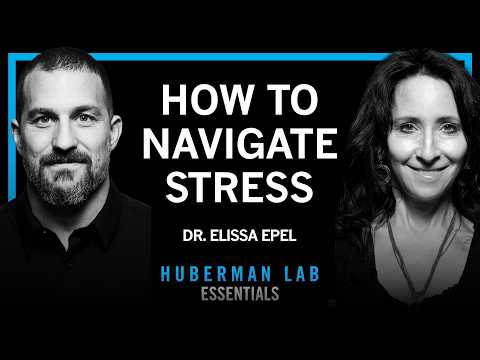

In this Huberman Lab Essentials episode, my guest is Dr. Elissa Epel, PhD, a Professor of Psychiatry and Behavioral Sciences at the University of California, San Francisco (UCSF). We discuss how acute and chronic stress affect the body and brain, including their links to cellular aging and mitochondrial health. We also explain tools to reduce rumination, reframe stress as a challenge and build resilience, as well as how radical acceptance and a sense of purpose can help us navigate stressors we cannot change.
Show notes: https://go.hubermanlab.com/fqVKGyP
Huberman Lab
Instagram: https://www.instagram.com/hubermanlab
Threads: https://www.threads.net/@hubermanlab
X: https://x.com/hubermanlab
Facebook: https://www.facebook.com/hubermanlab
TikTok: https://www.tiktok.com/@hubermanlab
LinkedIn: https://www.linkedin.com/in/andrew-huberman
Dr. Elissa Epel
LinkedIn: https://www.linkedin.com/in/elissa-epel
Instagram: https://www.instagram.com/elissa.epel
X: https://x.com/Dr_Epel
Timestamps
00:00:00 Elissa Epel
00:00:22 Good & Bad Stress, Stress Responses
00:01:55 Rumination, Body Awareness
00:03:23 Tools: Mindset, Body & Environment
00:04:51 Acute & Chronic Stress, Energy & Recovery
00:07:44 Sponsor: Eight Sleep
00:09:27 Healthy Aging, Purpose & Brain Health
00:10:54 Stress Resilience, Threat vs. Challenge
00:14:40 Tool: Reframe Stress, “Stress Shields”
00:16:54 Sponsor: AG1
00:18:30 Mitochondrial Health, Caregiving & Daily Mood
00:21:24 Chronic Stress, Tool: Radical Acceptance
00:25:19 Tool: “Drop the Rope”, Uncontrollable Stressors
00:26:48 Uncertainty, Tool: Posture & Slow Breathing
00:29:10 Sponsor: ROKA
00:30:34 Taking Action vs. Letting Go
00:32:55 Journaling, Narrative & Purpose
00:34:15 Acknowledgements
Disclaimer & Disclosures: https://www.hubermanlab.com/disclaimer
